
Mass Spectrometry
Different ionization techniques and mass detectors were developed that dramatically has increased the sensitivity, accuracy and resolution of the mass spectrometers in the last three decades. Also, the mass spectrometers were interfaced with liquid chromatography separation, further expanding the range of applications. Today, mass spectrometry analysis is an indispensable part of biopharmaceutical research.
At GlycoScreen we apply modern mass spectrometry techniques to the analysis of complex protein glycosylation using different mass spectrometric techniques:
MALDI-TOF MS (matrix assisted laser desorption ionization time-of-flight MS) is a mass spectrometry method that is widely used in glycomics. To increase desorption efficiency from the metal target glycans are generally derivatized by methylation, which also improves their fragmentation characteristics during MS/MS. The new generation MALDI mass spectrometers, in particular the UltrafleXtreme MALDI-TOF-TOF instrument (Bruker, Daltonics), allow a precise mass determination of glycopeptides and glycans as well as the fragmentation (PSD-MS/MS) of these to derive peptide or glycan sequence data. This increases the confidence in structural assignments based on merely molecular size determination.
LC-ESI-MS on a Q Exactive Orbitrap instrument (Thermo) combines high resolving power with high mass accuracy, at extremely high sensitivity and with fast aquisition rates due to multiplexing capabilities. It allows besides for global analysis of (glyco)peptides in complex mixtures for a targeted quantitative analysis of selected species at further increased sensitivity and with unprecedented specificity and confidence. Besides the high-resolution instrument we have access to a low-resolution high-capacity iontrap (HCT ETDII PTM Discovery, Bruker) that allows for alternative glycopeptide dissociation modes (electron-transfer-dissociation) that retain labile bound (O-linked) glycans at their sites and enable in this way the site localization of glycans.
MALDI-ISD (matrix assisted laser desorption ionization - in-source decay) can be used for the simultaneous sequencing of protein N- and C-termini covering a range of up to 80 amino acids from both sides. The in-source ladder sequencing avoids cleaving the sample with chemicals or enzymes. In contrast to Edman sequencing, MALDI-ISD will also sequence blocked termini, and is less cost-intensive and time consuming. Although isobaric amino acids are not discriminated and X-Pro diads are not cleaved by the electron-transfer-dissociation-like process the top-down sequencing method has evolved to a substitute of conventional Edman sequencing. On top of this, ISD-MALDI application can reveal insight into glycosylation sites and into the generally observed microheterogeneity of glycosylation at Ser/Thr residues (Hanisch, 2011).

MALDI-TOF Mass Spectrometry in Glycomics
MALDI-MS can be employed in a wide range of biochemical applications ranging from peptides to proteins and glycans. At GlycoScreen we use the technique preferentially in the context of glycoprofiling, which is based on the positive-ion reflectron-mode detection of permethylated glycans as their sodium adduct ions. Determination of the molecular masses allows the calculation of the monosaccharide composition in terms of N-acetyl or N-glycolylneuraminic acid, deoxyhexose, hexose, and N-acetylhexosamine. Identification of the monosaccharides can be performed either by monosaccharide analysis or methylation analysis applying combined gas-chromatography-mass spectrometry (GC-MS). Sequence information on the glycan under study can be obtained by performance of MS/MS in the post-source mode of laser-induced fragments.
The sample is mixed with a matrix, crystallized on a MALDI target and ionized using a UV laser system. The ions are then detected in a time-of-flight analyzer. The data sets are then imported into a relational database for further data reprocessing and evaluation.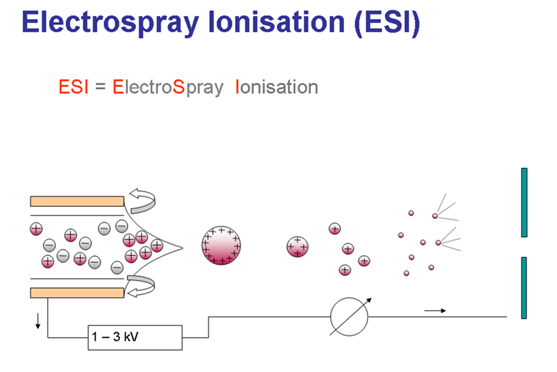
ESI-MS
Liquid chromatography coupled with electrospray ionization MS (LC-ESI-MS and LC-ESI-MS/MS) is preferentially used for the site determination of glycans in O- or N-glycopeptides. Glycopeptides in mixture with peptides are easily detectable by recording oxonium ions of glycans and using data-dependent acquisition methods MS/MS in the collision-induced dissociation (CID) or electron-transfer-dissociation (ETD) mode are triggered to obtain sequence data.
MALDI-ISD
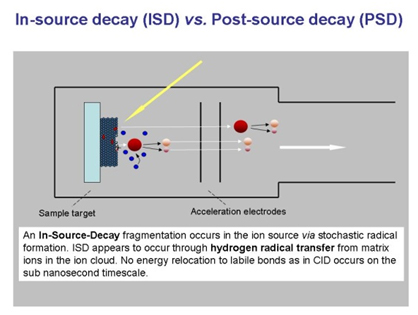
MALDI-ISD uses the fragmentation of (glyco)peptides within the ion source that is induced by hydride ions from the matrix. The electron-transfer-dissociation (ETD)-like process results in a more even random-like fragmentation of peptide bonds and does not induce cleavage of the thermolabile bonds of O-linked sugars, like the GalNAc-O-Ser/Thr bond. Hence, this method allows for the localization of O-glycosylation sites comparable to ESI-applications in the ETD mode.
The intact protein is mixed with a matrix (preferentially dihydroxy benzoic acid for simultaneous N- and C-terminal sequencing, and 1,5 diaminonaphtalene for preferential N-terminal sequencing), crystallized on a MALDI target and ionized using a Smartbeam laser. The in-source ions are then detected in a time-of-flight analyzer. The data sets are then imported into a data evaluation software (biotools) for further data reprocessing.
GC-MS
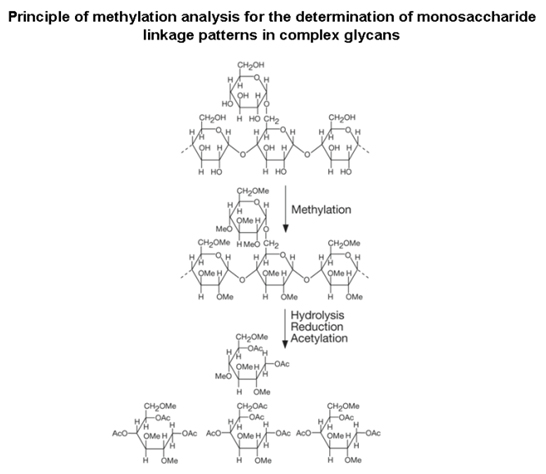
The combination of gas-chromatography and mass spectrometry (GC-MS, MD800, Thermo) is generally used to separate small molecules in derivatized form in the gas phase. The analytes after separation on a capillary gas-chromatographic column enter the ion-source of a quadrupole mass filter instrument, where they are bombarded by an electron beam (electron-impact-ionization). At GlycoScreen we use this technique to separate either trimetylsilylated 1-O-methylglycosides during monosaccharide analysis or partially methylated alditol acetates during methylation analysis for the determination of linkage patterns in complex glycans (Linkage Analysis by GCMS)